Haven Platform · Stabilization Ops

Void TrailsStabilization Crew

The cores of the nomad worlds are failing. Answer Haven's call: mine each planet, seal every cell of its containment lattice and get every colonist to the ark before the quakes win.

  • iPhone · iPad · Mac
  • Plays offline
  • No ads · No tracking
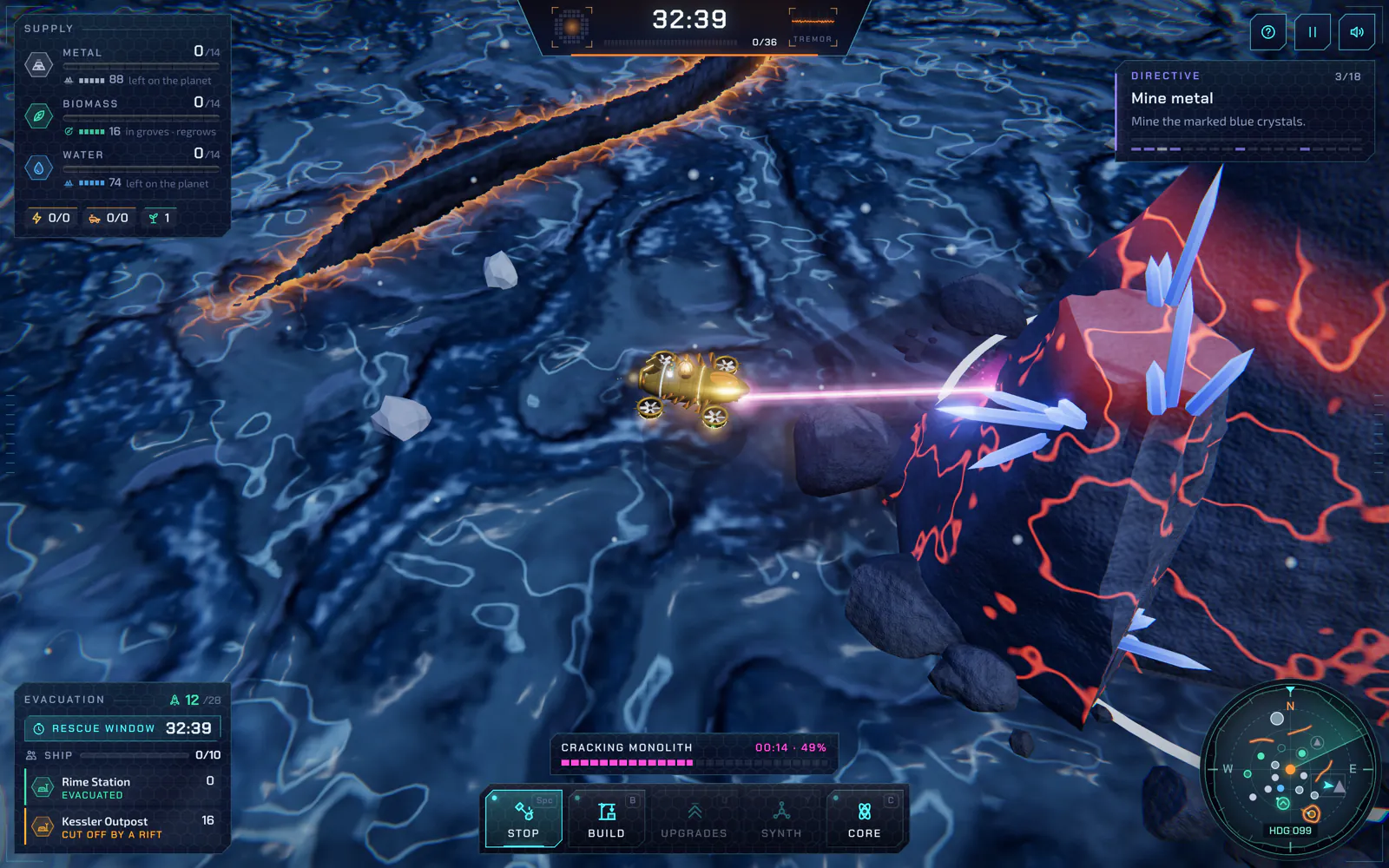
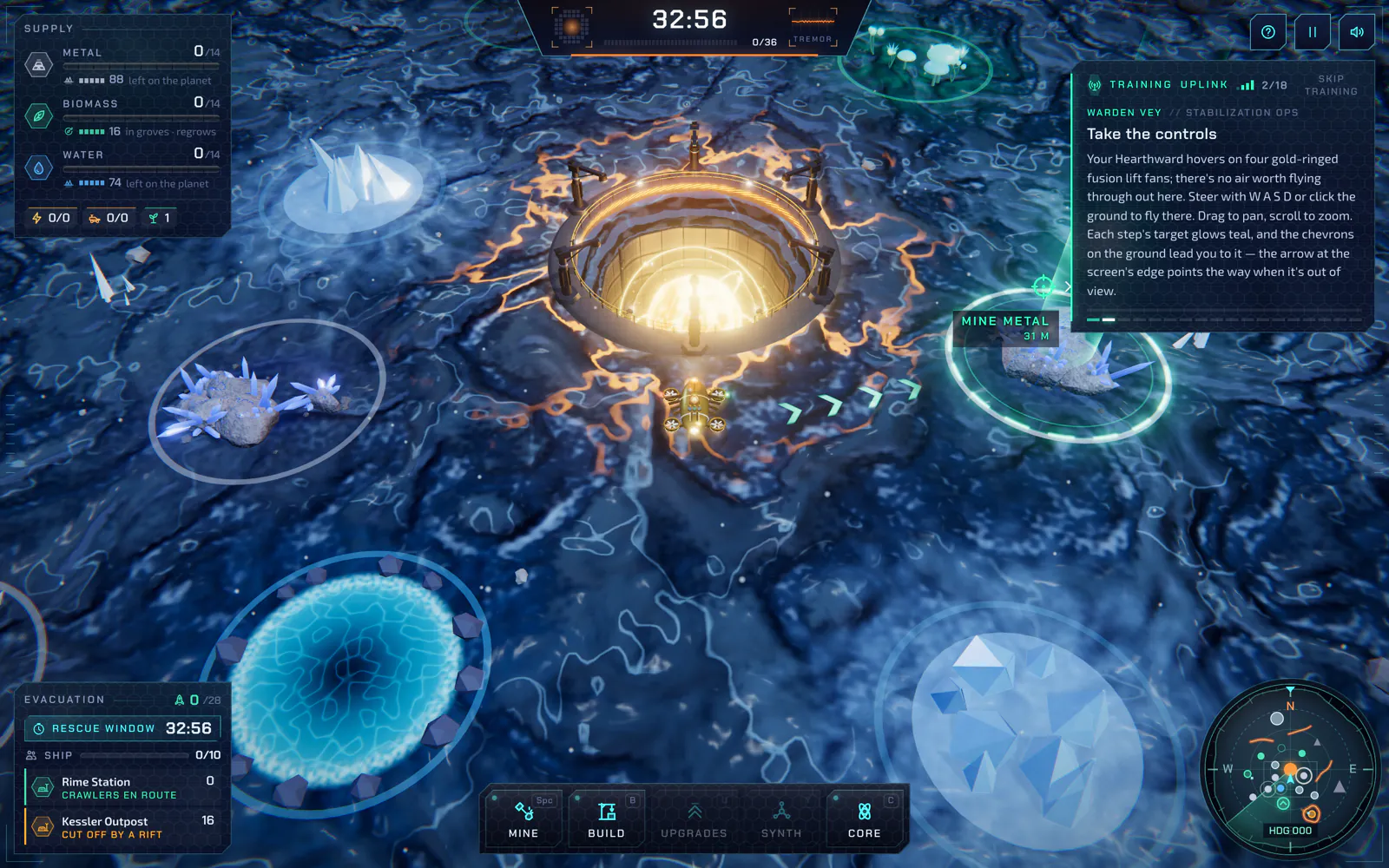
A Hearthward hovers over the molten core of Nomad Tiro while Warden Vey's training uplink explains the controls.

Real-time strategy with a rescue at its heart

Strategy without warfare

Void Trails: Stabilization Crew is a real-time strategy game about saving people, not fighting them. There are no armies to raise and no one to conquer. Your opponent is the clock, and a planet coming apart beneath you.

Your ship is an unarmed mining and rescue tender. Fly in, build a base, put a fleet of rovers to work, seal the core and get every last colonist aboard the ark before the quakes hit. Every mission is a rescue, and you win by bringing everyone home.

  • Seal the core

    Every core is wrapped in a containment lattice that has to be sealed cell by cell: a spatial puzzle inside a strategy game, paid for with what you mined.

  • Save every colonist

    A planet is only saved once everyone is aboard the ark. Bridge the rifts for the crawlers, or fly people out yourself where no road reaches.

  • Two clocks at once

    Seal the core before it collapses, and finish the evacuation before the quakes close the rescue window.

  • Build and automate

    Raise Power Generators, Rover Assemblies, Storage Depots, an Engineering Bay and a Molecular Synthesizer, then put rovers to work.

  • Budget every unit

    Each planet holds only so much metal and water, and the core has to be paid for out of it. Only biomass grows back.

  • Five cultures, five ships

    Fly a craft built by the Taramyn, Verdant, Ishikari, Mercurial or Sunyakyn, each with its own handling, laser, seats, hold and perk.

  • Ranks and leaderboards

    Rise from Recruit to Void Marshal, earn 17 Game Center achievements and chase the best time on every planet.

  • Private by design

    No accounts, no ads and no tracking. The apps play fully offline and collect no data.

Incoming transmission Haven Platform // Stabilization Ops

A message from Warden Vey

Pilot, this is Warden Vey, Stabilization Ops on Haven Platform. Welcome to the Stabilization Crew.

The nomad worlds drift through the Void with no sun of their own. The fire in their cores is all that keeps them warm, and those cores are failing. A world that loses its core shakes itself apart long before it goes dark, and everyone living on it goes with it.

That's our work. We seal each dying core inside a containment lattice, and we get every colonist aboard a Haven ark before the quakes bring their homes down. Sealing the core buys a planet a future; the arks give its people one. A world is not saved until its people are.

Out there the ground splits without warning, the core clock never stops, and no one else is coming. Start on Tiro and learn the work. Vey out.

End of transmission

The Chronicle

The story so far

Fifteen thousand years of history, five cultures born in the dark, and the crew that answers when a world starts to die. The same chronicle waits in the game, on the home screen.

The Void Trails · Part one

  1. The Cataclysm

    Fifteen thousand years ago, a wave of inexplicable cataclysms swept across the universe. Stars that should have burned for billions of years collapsed without warning. Entire civilizations vanished in fire. Those who survived fled into the Void — the dark spaces between stars that had always been considered empty and hostile.

  2. Discovery in Darkness

    There, the refugees discovered that emptiness was an illusion. Dark matter currents flowed like invisible rivers. Quantum tides ebbed and surged. Forgotten treasures filled planets suspended in darkness. The Void was full of things no one had learned to see.

  3. Five Cultures

    From the ashes of the old universe, five distinct cultures emerged: the Taramyn, who carry the memory of their lost sun and harness stellar fire as sacred ancestry; the Verdant, who merged with their ships to create living vessels that grow, heal, and cycle resources eternally; the Ishikari, industrial survivors who hunt stone and build craft tough enough to endure anything; the Mercurial, fast-moving opportunists who travel light and adapt to whatever the moment requires; and the Sunyakyn, void-dwellers who forgot their origins and learned to harness antimatter and probability itself.

  4. The Void Trails

    Now these five civilizations trade, compete, and coexist across the darkness — meeting at scattered stations, navigating treacherous routes for critical resources, and testing their pilots against one another on the legendary Void Trails.

The Stabilization Crew · Part two

  1. The Nomad Worlds

    The planets suspended in darkness were never meant to hold anyone. Nomad worlds drift between the stars with no sun of their own, warmed only by the fire still burning in their cores. The five cultures settled them anyway — for their ore, their ice and the glowing groves that grow without light — and built outposts, cloisters and cities on plates of crust that float above those fires. Haven's chartmakers name each world in the old tongue for its temper: mild Clemens, warm Calida, ember-strewn Favilla, singing Canora, grave Gravis.

  2. The Failing

    Then the cores began to fail, one world after another, the way the old stars did: without warning. A nomad world that loses its core shakes itself apart long before it goes dark, and everyone living on it goes with it.

  3. Haven's Call

    Haven Platform, the sanctuary station that offers repairs to any who can reach it, sounded the call, and pilots of all five cultures answered. Rivals on the Void Trails, they work these worlds as one crew: they mine what each planet holds, raise a base, seal the dying core inside a containment lattice — and get every colonist aboard a Haven ark before the quakes bring the colonies down.

  4. The Lattice

    The containment lattice is older than the crew. Its geometry was copied from an Energy Lattice, one of the webs of pure energy left in the Void by beings who transcended physical form. No one knows why the pattern holds a failing core together. It does, as long as every cell is sealed.

  5. Stabilization Ops

    Warden Vey runs Stabilization Ops from Haven and keeps the crew's only rule: a world is not saved until its people are. Sealing the core buys the planet a future; the arks give its people one.

Born in the Void

The five cultures

Fifteen thousand years ago the stars began to die, and the survivors fled into the Void. Five cultures came out of it, and on Haven's crew their pilots work as one. Every colony belongs to a culture, and you can see it in the colony's colours, its colonists' suits and its landmark.

Taramyn

Star-kin

“From light, all power flows.”

Harness the power of stars with efficient hydrogen fusion.

The Taramyn call a nomad world's core a buried star, and to them a failing one is a second sun going out. Their sun-priests were the first to answer Haven's call, and their tenders carry the Solar Aegis that braces a core while the lattice goes up.

Settlers
Sun-priests
Landmark
Sun spire
Ship
Hearthward
Colonies
Emberwell (Nomad Calida), Ashfall Vigil (Nomad Favilla), Cinderveil (Nomad Gravis)
Their history

The Taramyn remember fire.

Ten thousand years ago, their ancestors watched their home star swell and die — a supernova that scattered their civilization across the void. What could have been extinction became transformation. The Taramyn did not flee the light; they carried it with them.

Their name means "star-kin" in the old tongue, and they take this literally. Taramyn philosophy holds that stellar fire is not merely energy but sacred ancestry — that their lost sun lives on in every fusion reactor they ignite, every hydrogen atom they burn. To harness a star is to commune with the dead. Their ships are temples as much as vessels, their engineers part technician and part priest.

The Taramyn govern through consensus, believing that unity preserved them during the exodus and unity will carry them forward. Decisions ripple outward from small councils to larger assemblies, patient as stellar nucleosynthesis. They do not rush. Stars burn for billions of years; the Taramyn plan on similar timescales.

Their technology emphasizes endurance and efficiency over raw power. A Taramyn vessel is designed to operate for centuries, its fusion cores stable and clean, its solar collectors drinking light with quiet gratitude. They find the Verdant's organic chaos unsettling and the Mercurial's improvisation reckless — but they reserve their deepest unease for the Sunyakyn, who abandoned light entirely for the cold mathematics of the void.

Every Taramyn ship carries a Remembrance Core: a sealed chamber containing hydrogen harvested from their original sun before its death. They will never burn it. It is the last ember of home, carried forward until the universe itself grows cold.
Verdant

The Cultivators

“Life sustains life.”

Grow your fuel, heal your ship, and cycle resources endlessly.

To the Verdant a dying world is still part of the Cycle, but its people are not compost yet. They seeded the glowing groves on half the nomad worlds, and their living holds carry more evacuees than any hull of metal.

Settlers
Seed-tenders
Landmark
Grove tree
Ship
Seedwarden
Colonies
Kessler Outpost (Nomad Tiro), Mossgate (Nomad Clemens), Greenbrine (Nomad Salina)
Their history

The Verdant do not build. They cultivate.

Their origins are obscured by choice — they keep no written histories, believing that the past should decompose like fallen leaves, feeding new growth. What is known: they were once conventional spacefarers who faced extinction when their fleet's resources ran dry between stars. In desperation, they merged with their ships, seeding them with engineered organisms, transforming dead metal into living tissue.

They survived. And they learned.

Verdant philosophy centers on the Cycle — the understanding that nothing is created or destroyed, only transformed. Waste is food. Death is fertilizer. A Verdant ship breathes, heals, grows, and eventually dies, its biomass recycled into new vessels. They find the concept of "fuel" almost quaint; their ships eat, digest, and regenerate. Damage that would cripple other vessels simply regrows over time.

Their culture is patient and organic in structure. Leadership emerges naturally, like fruiting bodies rising from mycelium, then recedes when no longer needed. They make decisions slowly, allowing ideas to germinate, testing them in small ways before committing. Verdant who rush are considered immature — still thinking like metal-dwellers.

They view the Taramyn with gentle pity: still burning, still consuming, still trapped in the old paradigm of extraction. The Ishikari they find tragic — so obsessed with breaking stone they've forgotten how to grow. But they trade with all, offering bio-engineered organisms, medical expertise, and the quiet certainty that their way will outlast the others. Stars die. Mines empty. But life always finds a way.

Ishikari

Stone-hunters

“The void takes. We take back.”

Survive anything with heavy armor and industrial-grade drives.

The Ishikari came to the nomad worlds for the ore and stay for the work. Nobody cracks a monolith faster, and nobody complains less about the dirt; the Void Drillers guild seconds a hauler to every crew Haven sends out.

Settlers
Guild miners
Landmark
Mine headframe
Ship
Stonebreaker
Colonies
Rime Station (Nomad Tiro), Brinehold (Nomad Salina), Cinder Hollow (Nomad Favilla), Anvilreach (Nomad Gravis)
Their history

The Ishikari hunt stone.

Their ancestors were miners on a barren moon, extracting ore for distant masters who never came to collect. When the empire that employed them collapsed, they were left with nothing but rock, tools, and the hard-won knowledge that survival belongs to those who dig. They dug. They survived. They became something new.

Ishikari philosophy is brutally practical: the universe is hostile, resources are finite, and sentiment is a luxury for those who have never watched their air supply dwindle. They do not worship stone — worship implies separation. They understand stone. They read asteroid composition the way poets read verse. They know which rocks are worth cracking and which will fight back. Their word for a rich ore deposit translates roughly as "worthy prey."

Their ships reflect this worldview: heavy, armored, functional. An Ishikari vessel is not beautiful, but it will survive impacts, radiation, and hazards that would vaporize sleeker designs. They build to last, to endure, to keep working long after prettier ships have become debris. Redundancy is religion. Every system has a backup. Every backup has a backup.

Governance is guild-based, organized by specialization — the Iron Seekers, the Void Drillers, the Slag Refiners. Respect flows to those who produce. Talk is cheap; tonnage extracted is truth. They view the Taramyn as dreamers clinging to a dead sun, the Verdant as soft organisms who would wilt in a real crisis. The Mercurial they tolerate — someone has to move the ore — but trust is earned in cubic meters, not clever words.

Their saying: "The void takes. We take back."

Mercurial

The Quick

“The rigid break. The quick eat.”

Speed, flexibility, and a talent for acquisition.

Ask a Mercurial pilot why they signed on with Haven and they'll tell you it was for the salvage rights. Then they fly more rescue runs than anyone else on the crew, and deny every one of them.

Settlers
Traders
Landmark
Trade beacon
Ship
Quickhand
Colonies
Lantern Rest (Nomad Clemens), Ledger Point (Nomad Salina), Glimmer Outpost (Nomad Canora), Quickfall (Nomad Gravis)
Their history

The Mercurial remember nothing because they choose to.

They claim no homeworld, no founding myth, no ancestral tragedy. Ask a Mercurial where they came from and you'll get a different story every time — each tale more elaborate, more contradictory, more entertaining than the last. This is not deception; it is philosophy. The past is inventory that weighs you down. Travel light.

Mercurial culture prizes adaptability above all. Their ships are fast, modular, endlessly reconfigurable. Their universal converters can burn nearly any fuel — hydrogen, organic matter, refined ore, salvage. They have been accused of stealing; they prefer the term "reallocation." Resources flow to those who can use them. The Mercurial can always use them.

They organize in loose affiliations rather than rigid structures — crews form, dissolve, and reform based on opportunity. Leadership is situational: whoever has the best plan for the current job leads until the job is done. Loyalty exists but is personal, not institutional. A Mercurial will die for a crewmate; they will not die for a flag.

Other civilizations find them frustrating: unreliable, opportunistic, impossible to pin down. The Taramyn think them chaotic. The Ishikari think them lazy. The Verdant think them disconnected from natural cycles. The Mercurial consider this criticism hilarious. They have survived just as long as anyone else — longer than some — by being exactly what each moment requires.

Their proverb: "The rigid break. The quick eat."

They know things. They go places. They can get what you need, for a price. Don't ask where it came from.

Sunyakyn

The Order

“Empty your hands to hold everything.”

Master probability and harness the power of antimatter and exotic matter.

The Sunyakyn say the containment lattice is a sentence in a language they almost remember, and they seal its cells as if finishing a prayer. Whether they joined the crew to save the nomad worlds or to study them, they have never said.

Settlers
Initiates
Landmark
Null obelisk
Ship
Stillpoint
Colonies
Stillmere (Nomad Calida), Prism Falls (Nomad Canora), Null Spire (Nomad Gravis)
Their history

The Sunyakyn remember only the void, and the void remembers nothing.

If they had origins — a homeworld, a parent star — that knowledge has been lost, deliberately or otherwise. Their earliest records describe only darkness, and a revelation: that emptiness is not absence but abundance. The visible universe — stars, planets, matter — is the minority. The Sunyakyn learned to see the rest.

Their philosophy derives from the ancient concept of śūnyatā: emptiness as pregnant potential, void as infinite possibility. Where others see nothing between stars, the Sunyakyn see dark matter scaffolding, quantum foam, probability fields waiting to collapse into reality. They do not merely harvest exotic matter and antimatter — they commune with the underlying structure of existence itself.

This communion grants them abilities others consider impossible. Their probability manipulation is not magic but mathematics: a deep understanding of quantum uncertainty that allows them to weight outcomes, to make the unlikely likely. Their antimatter drives fold space in ways that seem to violate physics. They arrive where they should not be, survive what should kill them, know things they should not know. Other civilizations find this unsettling. The Sunyakyn find their discomfort irrelevant.

The Sunyakyn Order is contemplative, hierarchical, and patient. Initiates spend decades in meditation, learning to perceive dark matter flows, to quiet the noise of expectation that blinds other minds. Masters speak rarely and act decisively. They do not seek territory or wealth; they seek understanding. The universe is a puzzle, and they are very close to solving it.

They view the other civilizations with distant compassion. The Taramyn cling to fire. The Verdant cling to life. The Ishikari cling to matter. The Mercurial cling to motion. All of them cling. The Sunyakyn released their grip long ago and found that the void held them anyway.

Their teaching: "Empty your hands to hold everything."

New Halcyon, on Nomad Canora, is a crossroads: a city of all five cultures flying a concord of their banners, home to 160 colonists of every culture.

7 planets · Training to Expert

The nomad worlds

Every planet has its own terrain, resources, colonies and challenges: the frozen slate of Tiro, the glowing moss of Clemens, the steaming springs of Calida, the salt flats of Salina, the lava fields of Favilla, the singing crystal of Canora and the shattered obsidian of Gravis. They're played in order, and stabilizing a planet unlocks the next.

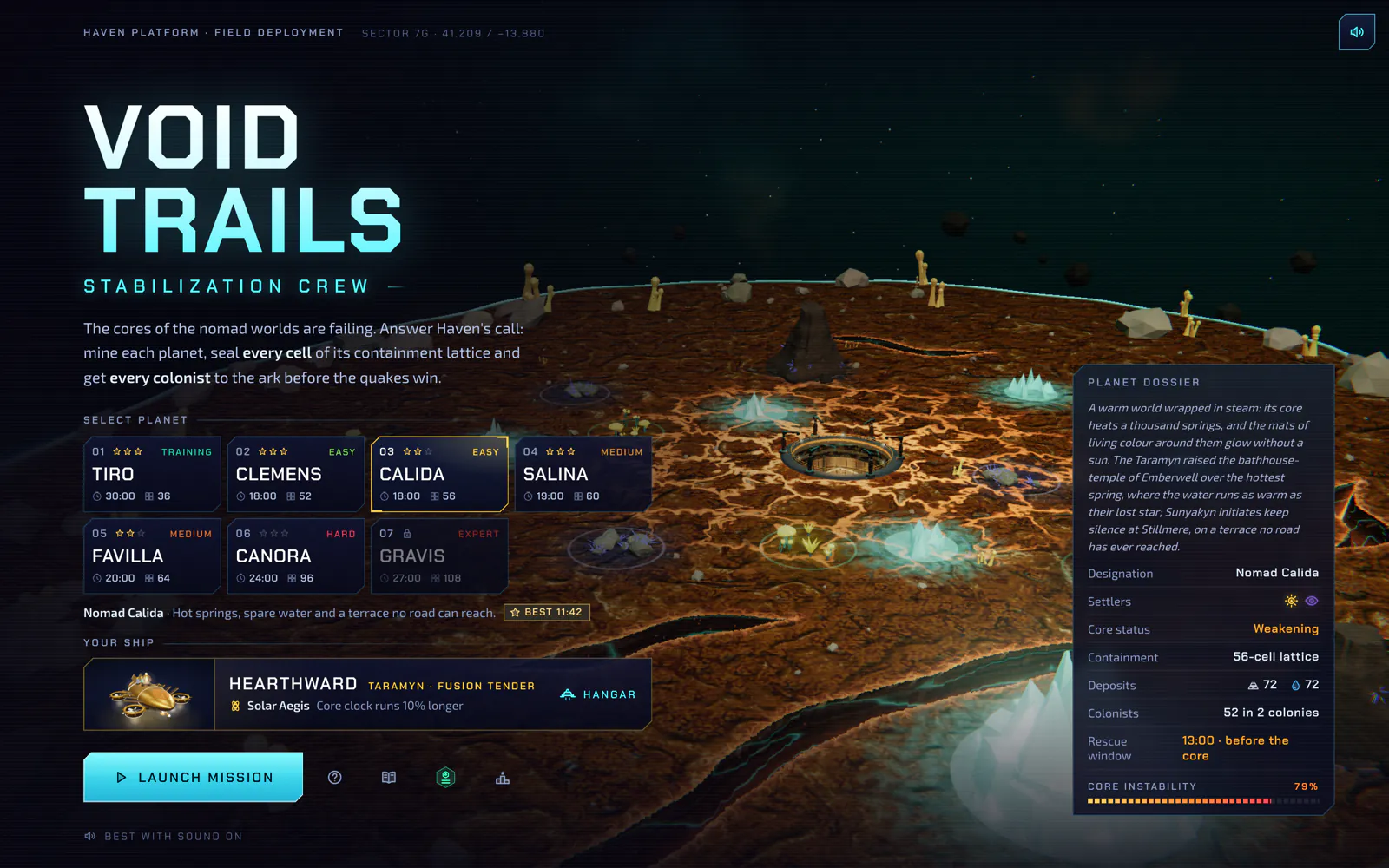
The home screen: the planet select, Nomad Calida's dossier and the Hearthward, over the steaming springs of Calida.

A planet is only saved once every colonist is aboard the ark, even if the core is already sealed. Crawlers drive colonists to the ark where they can reach it. Rifts can cut a colony off, so you may need to build a bridge or fly people out in your ship. On harder planets, quakes close the rescue window well before the core gives way.

Planet 01 · Training Free

Nomad Tiro

Learn to mine, build and seal a small lattice.

A young nomad world at the edge of the Void Trails. Haven's charts call it Tiro, the recruit, because every new crew learns the work here. Ishikari guilds cut ice at Rime Station; Verdant seed-tenders keep a vault of living stock at Kessler.

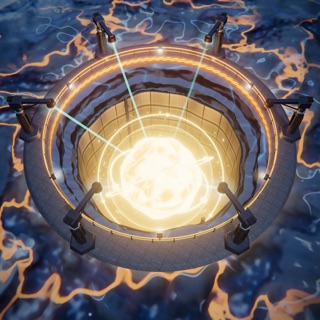
Terrain. A frozen slate planet under blue skies. Blue crystal ore, fungus groves, and a molten core at the bottom of a steel-cased borehole ringed by a railed service deck.

Colonies

  • Rime StationIshikari outpost · 12 colonists
  • Kessler OutpostVerdant outpost · 16 colonists
  • Ark Meridianthe evacuation ark

Training

  • A guided training run. Warden Vey talks you through mining, melting ice and planting seeds, then building a Power Generator and a Rover Assembly, deploying a rover and sealing the lattice.
  • Each step's target is marked in the world with a column of light, and a trail of chevrons leads there from your ship.
  • Metal and water lie close to the start, including a meltwater pool the core's heat keeps from freezing.
  • Only Tiro has a guided lattice: the stabilizer won't take a piece that would leave cells no base piece can fill.
  • A rift rings Kessler Outpost, so its crawlers need a bridge at Kessler Crossing.
  • The core clock runs from the start, briefings included, and you can skip the training at any time.
Epilogue · spoiler

Rime's ice-cutters and Kessler's seed vault are safe aboard Ark Meridian. The guilds will remember who came for them.

Core statusUnstable · 64%
Core clock
30:00
Lattice
36 cells
Metal · water
88 · 74in the deposits
Colonists
28in 2 colonies
Rescue window
30:00runs with the core clock
Pirates
None
The containment lattice around the core

Planet 02 · Easy Free

Nomad Clemens

A mild garden world with metal and water to spare.

The gentlest of the failing worlds: its core still runs warm enough that the Verdant grew a garden across half the planet. Their seed-keepers tend the terraces of Mossgate, and Mercurial cartographers chart the old root tunnels from Lantern Rest.

Terrain. A damp world carpeted in moss, lichen and glowing spores, with roots trailing from its underside. Amber ore needles, bulb-topped stalks, jade lakes, fungus groves, and a molten core at the bottom of a borehole.

Colonies

  • MossgateVerdant settlement · 40 colonists
  • Lantern RestMercurial outpost · 14 colonists
  • Ark Sorrelthe evacuation ark

Mission briefing

  • The core of Nomad Clemens is faltering.
  • Seal all 52 lattice cells within 18:00.
  • Quakes will level the colonies in 14:00 — get all 54 colonists to Ark Sorrel.
  • This lattice seals with plates, elbows and strands alone — no Synthesizer needed. If cells get cut off, pull a piece back out for a full refund.
  • A rift walls off Lantern Rest — bridge it so the Mercurial crawler can drive out.
Epilogue · spoiler

Ark Sorrel climbs away with Mossgate's gardens packed in its holds. On Lantern Rest's last map, the cartographers drew your ship.

Core statusFaltering · 72%
Core clock
18:00
Lattice
52 cells
Metal · water
74 · 64in the deposits
Colonists
54in 2 colonies
Rescue window
14:00closes before the core
Pirates
None
The containment lattice around the core

Planet 03 · Easy Full version

Nomad Calida

Hot springs, spare water and a terrace no road can reach.

A warm world wrapped in steam: its core heats a thousand springs, and the mats of living colour around them glow without a sun. The Taramyn raised the bathhouse-temple of Emberwell over the hottest spring, where the water runs as warm as their lost star; Sunyakyn initiates keep silence at Stillmere, on a terrace no road has ever reached.

Terrain. Rust and ochre ground wrapped in steam, its seams glowing teal. Steaming turquoise springs ringed with sinter and sulfur terraces, amber stalks, violet ore needles, fungus groves, and a magma core at the bottom of a borehole.

Colonies

  • EmberwellTaramyn settlement · 38 colonists
  • StillmereSunyakyn outpost · 14 colonistsNo vehicles: its people have to be flown out
  • Ark Vesperthe evacuation ark

Mission briefing

  • The core of Nomad Calida is weakening.
  • Seal all 56 lattice cells within 18:00.
  • Quakes will level the colonies in 13:00 — get all 52 colonists to Ark Vesper.
  • No road reaches Stillmere — fly its Sunyakyn initiates to the ark yourself.
  • Plates, elbows and strands seal this lattice too, and the springs give water to spare. Pull a piece back out if it cuts cells off.
  • A rift cuts off the eastern springs — bridge it so your rovers can reach the deposits beyond.
Epilogue · spoiler

Ark Vesper lifts out of the steam with Emberwell's sun-priests and Stillmere's initiates aboard. The springs will run on long after anyone is left to bathe in them.

Core statusWeakening · 76%
Core clock
18:00
Lattice
56 cells
Metal · water
72 · 72in the deposits
Colonists
52in 2 colonies
Rescue window
13:00closes before the core
Pirates
None
The containment lattice around the core

Planet 04 · Medium Free

Nomad Salina

Salt flats, scarce water and three colonies to clear.

A pale world of salt pans and brine, its seas boiled off long ago by a core that ran too hot. Ishikari evaporators work the brine at Brinehold, Mercurial traders still settle their debts in Salina salt at Ledger Point, and Verdant seed-tenders coax a green belt out of the pans at Greenbrine.

Terrain. A salt flat: pale polygon crust over damp brine, rose brine pools with salt-crystal shores, pink salt prisms and anemone groves, with a magma core in a caldera.

Colonies

  • BrineholdIshikari settlement · 42 colonists
  • Ledger PointMercurial outpost · 14 colonists
  • GreenbrineVerdant outpost · 12 colonistsNo vehicles: its people have to be flown out
  • Ark Wayfarerthe evacuation ark

Mission briefing

  • The core of Nomad Salina is failing!
  • Seal all 60 lattice cells within 19:00.
  • Quakes will level the colonies in 11:00 — all 68 colonists must reach Ark Wayfarer.
  • Water is scarce on the salt. This lattice needs only four Coolant Elbows — seal the rest with plates and strands.
  • A crevasse cuts Ledger Point's Mercurial traders off from the ark — bridge it so their crawler can drive out.
  • Greenbrine has no vehicles — fly its seed-tenders out yourself.
  • A brine glacier beyond the crevasse holds 18 water — melting it in good time takes an upgraded Mining Laser.
Epilogue · spoiler

Ark Wayfarer climbs off the salt with three cultures aboard. At Ledger Point the Mercurial wrote off every debt on the books, except the one they owe your crew.

Core statusFailing · 81%
Core clock
19:00
Lattice
60 cells
Metal · water
90 · 41in the deposits
Colonists
68in 3 colonies
Rescue window
11:00closes before the core
Pirates
None
The containment lattice around the core

Planet 05 · Medium Full version

Nomad Favilla

A tight 64-cell ring, with pirates circling Cinder Hollow.

A basalt world whose core burns hot enough to keep embers falling like snow; the old tongue calls it Favilla, the glowing ash. Ishikari guild miners dug Cinder Hollow into its richest seam, and Taramyn sun-priests keep a vigil at Ashfall: they say the core's fire is the nearest thing to the star they lost. Lately pirate skiffs have been seen over the Hollow.

Terrain. Columnar basalt veined with lava. Amber ore prisms, steaming hot springs with mineral terraces, vent-worm groves, and a crusted magma core in a volcanic caldera.

Colonies

  • Ashfall VigilTaramyn outpost · 14 colonistsNo vehicles: its people have to be flown out
  • Cinder HollowIshikari settlement · 48 colonists
  • Ark Tollandthe evacuation ark

Mission briefing

  • The core of Nomad Favilla is collapsing!
  • Seal all 64 lattice cells within 20:00.
  • Quakes will level the colonies in 10:00 — get all 62 colonists to Ark Tolland before then.
  • Metal and water deposits never refill — spend them where the lattice needs them.
  • A rift cuts Cinder Hollow's Ishikari miners off from Ark Tolland — a bridge lets their crawlers out and your rovers reach the grove beyond.
  • A pirate crew has been circling Cinder Hollow, and the Hollow Battery beside it is wrecked. Weld it back online before they come — while raiders loot the colony, its people can't leave.
  • The Taramyn sun-priests of Ashfall Vigil have no vehicles — fly them to the ark yourself.
  • A giant monolith and a glacier sit at the edge of the map — upgrade your Mining Laser to open them in time.
Epilogue · spoiler

Ark Tolland climbs through the ash. At Ashfall, the sun-priests left a lamp burning for the crew that kept the fire alive.

Core statusCritical · 87%
Core clock
20:00
Lattice
64 cells
Metal · water
88 · 59in the deposits
Colonists
62in 2 colonies
Rescue window
10:00closes before the core
Pirates
1 raid1 wrecked turret to repair
The containment lattice around the core

Planet 06 · Hard Full version

Nomad Canora

A 96-cell lattice, scarce water — and pirates on the scanner.

A world of singing crystal far out on the Trails. The Sunyakyn came to Prism Falls to listen to it, and Mercurial traders followed to Glimmer to sell what they heard. New Halcyon, the largest city on any nomad world, was raised by all five cultures together.

Terrain. Faceted violet crystal. White ore needles, obsidian obelisks, crystal-ringed lakes, anemone groves, and a shattered geode core deep in a crystal-lined rift.

Colonies

  • Prism FallsSunyakyn settlement · 44 colonists
  • Glimmer OutpostMercurial outpost · 16 colonists
  • New Halcyoncity of all five cultures · 160 colonists
  • Ark Halcyonthe evacuation ark

Mission briefing

  • Nomad Canora is in cascade failure!
  • Seal all 96 lattice cells within 24:00 — deposits here are far apart.
  • Quakes will level the colonies in 12:00, long before the core gives way — all 220 colonists must reach Ark Halcyon.
  • New Halcyon's 160 colonists, people of all five cultures, are trapped inside a ring of rifts — bridge it so their crawlers can get out.
  • Pirates are working this system, and the core's 3 defense turrets are down. Repair them before the raiders come for the lattice.
  • Water is scarce. Check the lattice budget in the stabilizer before you build.
  • A rift walls off Glimmer Outpost's Mercurial traders, a metal deposit and the giant monolith in the east — rovers need a bridge to get there.
  • The glacier at the edge of the map holds 22 water — melting it in good time takes an upgraded Mining Laser.
Epilogue · spoiler

Ark Halcyon carries five cultures off a singing world. Somewhere aboard, a Mercurial is already selling the story.

Core statusCascading · 95%
Core clock
24:00
Lattice
96 cells
Metal · water
88 · 56in the deposits
Colonists
220in 3 colonies
Rescue window
12:00closes before the core
Pirates
1 raid3 wrecked turrets to repair
The containment lattice around the core

Planet 07 · Expert Full version

Nomad Gravis

A 108-cell lattice, four colonies and two pirate raids.

The largest nomad world on the Trails, a black glass planet whose core bleeds red through every crack; the old tongue calls it Gravis, the heavy, the grave. Ishikari foundries raised Anvilreach on its richest ground, Taramyn pilgrims keep Cinderveil, Mercurial couriers run Quickfall and Sunyakyn mystics sit in silence at Null Spire. Pirate crews from the outer drift have been circling for weeks.

Terrain. Shattered obsidian: black plates split by glowing blue seams, with cinders drifting over them. Gold ore prisms, obsidian spires and shard fields, slab-ice lakes with crystal shores, vent groves, and a crystal core deep in a rift.

Colonies

  • AnvilreachIshikari city · 150 colonists
  • CinderveilTaramyn settlement · 44 colonists
  • QuickfallMercurial outpost · 16 colonists
  • Null SpireSunyakyn outpost · 18 colonistsNo vehicles: its people have to be flown out
  • Ark Bastionthe evacuation ark

Mission briefing

  • Nomad Gravis is minutes from total collapse!
  • Seal all 108 lattice cells within 27:00.
  • Quakes will level the colonies in 13:00 — all 228 colonists must reach Ark Bastion.
  • Two pirate raids are coming for the lattice and all 4 defense turrets are down. Repair them first — every raider that gets through rips out a piece.
  • Anvilreach's 150 Ishikari sit inside a ring of rifts, and a second rift cuts Quickfall off from the ark. Null Spire has no vehicles — fly the mystics out yourself.
  • Water is scarce and metal won't stretch far. Check the lattice budget before you build.
  • The giant monolith beyond the north-east rift holds 30 metal — you'll want a bridge and an upgraded laser.
Epilogue · spoiler

Ark Bastion breaks orbit under the guns you brought back to life. The pirates will find nothing left to take.

Core statusTerminal · 99%
Core clock
27:00
Lattice
108 cells
Metal · water
104 · 49in the deposits
Colonists
228in 4 colonies
Rescue window
13:00closes before the core
Pirates
2 raids4 wrecked turrets to repair
The containment lattice around the core

Haven Shipyards

Five cultures, five ships

Every culture builds its own craft for stabilization, rescue and mining, with its own handling, laser, seats and hold, and a culture perk that changes how you play. The Hangar on the home screen shows each ship hovering over the selected planet.

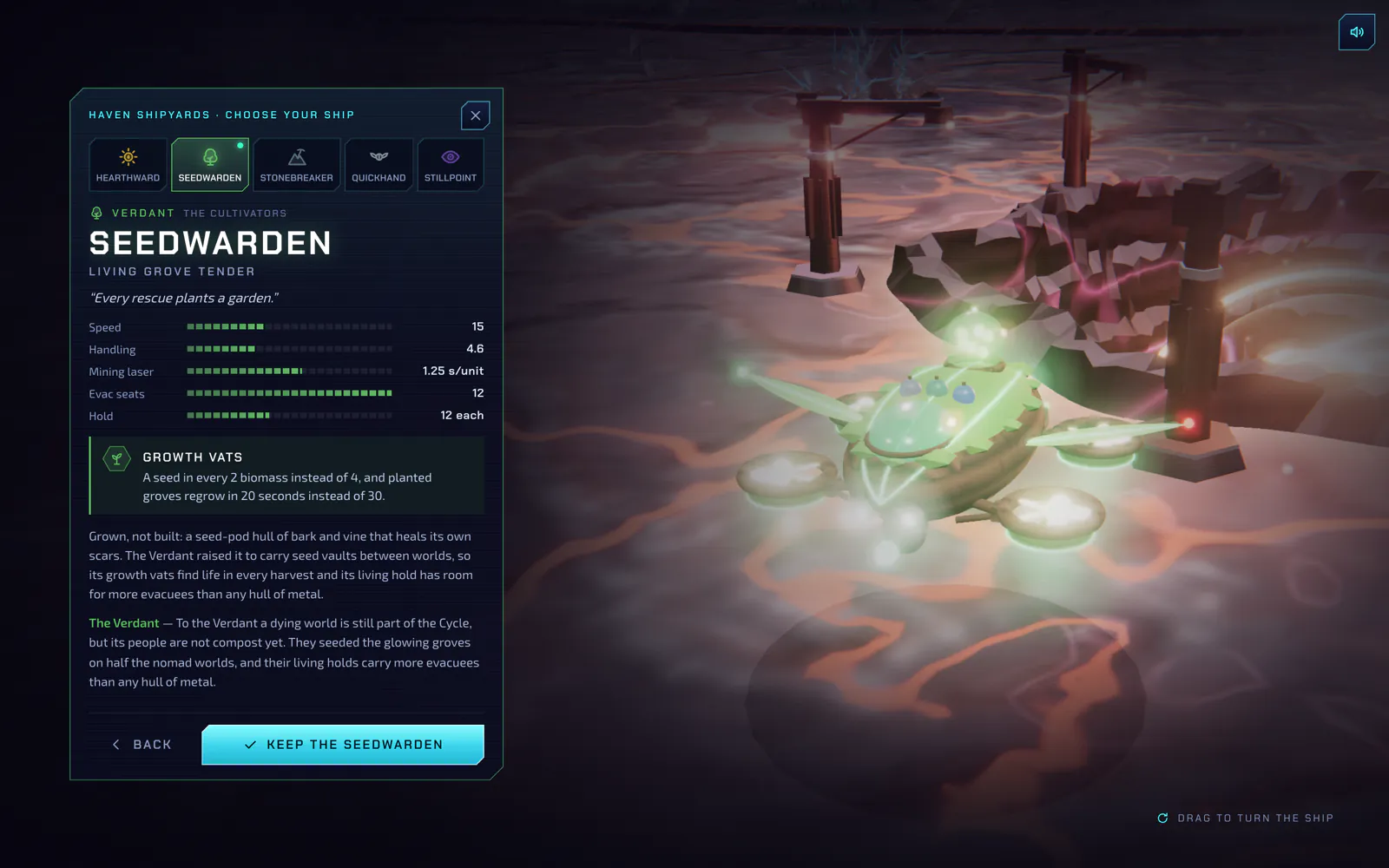
The Hangar: the Seedwarden's stats, Growth Vats perk and story, beside the ship itself.

Hearthward

Taramyn · Fusion tender

Free

“No fire goes out while we keep watch.”

Taramyn sun-priests built the Hearthward to keep buried fires from guttering out. Feathered collector vanes drink a core's heat, a Remembrance Core rides on its spine, and its fusion plant is clean enough to run beside a failing lattice for weeks.

Flies on four gold-ringed fusion lift fans.

Speed
16
Handling
5.0
Mining laser
1.25 s/unit
Evac seats
10
Hold
14 each
Solar Aegis

A golden containment field braces the core while you work: its collapse clock runs 10% longer.

Seedwarden

Verdant · Living grove tender

Full version

“Every rescue plants a garden.”

Grown, not built: a seed-pod hull of bark and vine that heals its own scars. The Verdant raised it to carry seed vaults between worlds, so its growth vats find life in every harvest and its living hold has room for more evacuees than any hull of metal.

Flies on four slow-turning petal rotors.

Speed
15
Handling
4.6
Mining laser
1.25 s/unit
Evac seats
12
Hold
12 each
Growth Vats

A seed in every 2 biomass instead of 4, and planted groves regrow in 20 seconds instead of 30.

Stonebreaker

Ishikari · Heavy mining hauler

Full version

“The rock gives. Eventually.”

Ishikari guild yards build haulers the way they hunt stone: armoured, redundant and patient. A breaker prow, a twin-barrel mining laser and ore bins deep enough to strip a deposit in one sortie. It is slow, and it does not care.

Flies on four caged heavy-lift fans.

Speed
14
Handling
4.0
Mining laser
1.13 s/unit
Evac seats
10
Hold
18 each
Breaker Prow

Melts ice and cracks monoliths 30% faster, giant glaciers and monoliths included.

Quickhand

Mercurial · Rapid-response courier

Full version

“First in, first out, everyone aboard.”

Mercurial couriers make their fortunes by getting there first. Polished chrome, oversized engines and a quick-swap passenger pod: the Quickhand carries fewer people than its rivals, but nobody loads or unloads them faster.

Flies on four vectoring thrust nacelles.

Speed
18.5
Handling
6.8
Mining laser
1.38 s/unit
Evac seats
8
Hold
10 each
Tractor Ramp

Colonists board and leave the ship twice as fast.

Stillpoint

Sunyakyn · Void-tap stabilizer

Full version

“In stillness, the lattice holds.”

Sunyakyn craft follow a geometry no one else uses. The Stillpoint floats on four null stones instead of fans, runs on a sliver of antimatter, and carries a probability engine that weights each cut of its laser toward the better outcome.

Flies on four floating null stones and a void-tap halo, with no fans at all.

Speed
16.5
Handling
7.5
Mining laser
1.19 s/unit
Evac seats
8
Hold
10 each
Probability Weave

Every unit you mine has a 1 in 6 chance to come out doubled.

Engine and laser upgrades scale from each ship's own stats. The Hearthward is free, and the full version adds the Seedwarden, Stonebreaker, Quickhand and Stillpoint.

Field manual

How to play

Two clocks run at once: seal the core before it collapses, and finish the evacuation before the quakes close the rescue window. Here's the work, step by step.

  1. Step 01

    Gather

    Click a deposit (or press Space near one; on touch screens, just tap it) and your ship flies there and mines it with its laser.

    • Frozen lakes must be melted first, and ore monoliths cracked, before they can be mined. The giant glaciers and monoliths at the edge of the map hold the most, and an upgraded laser opens them in time.
    • Mining biomass sometimes yields seeds. Plant them on withered groves to make them grow back.
    • Storage is limited (10 of each resource at first, plus your ship's hold), so spend as you go or build Storage Depots.

    Metal and water deposits never refill. Once a deposit is exhausted it's gone for good. Biomass is the only renewable resource. Buildings, rovers and upgrades spend from the same finite supply as the lattice, so overbuilding can leave you unable to seal the core.

    A Hearthward's mining laser cracking a giant ore monolith on the frozen slate of Nomad Tiro.
  2. Step 02

    Build

    Press B (or tap Build) and place structures on open ground. Power Generators supply the power for everything else, and you can only place a building while there's power to spare.

    Select a Rover Assembly to build rovers for 1 metal each. Rovers mine on their own, going for whatever you're lowest on, and haul it home while you fly elsewhere. Set their priorities in the supply panel, or select a rover and click a deposit to give it an order.

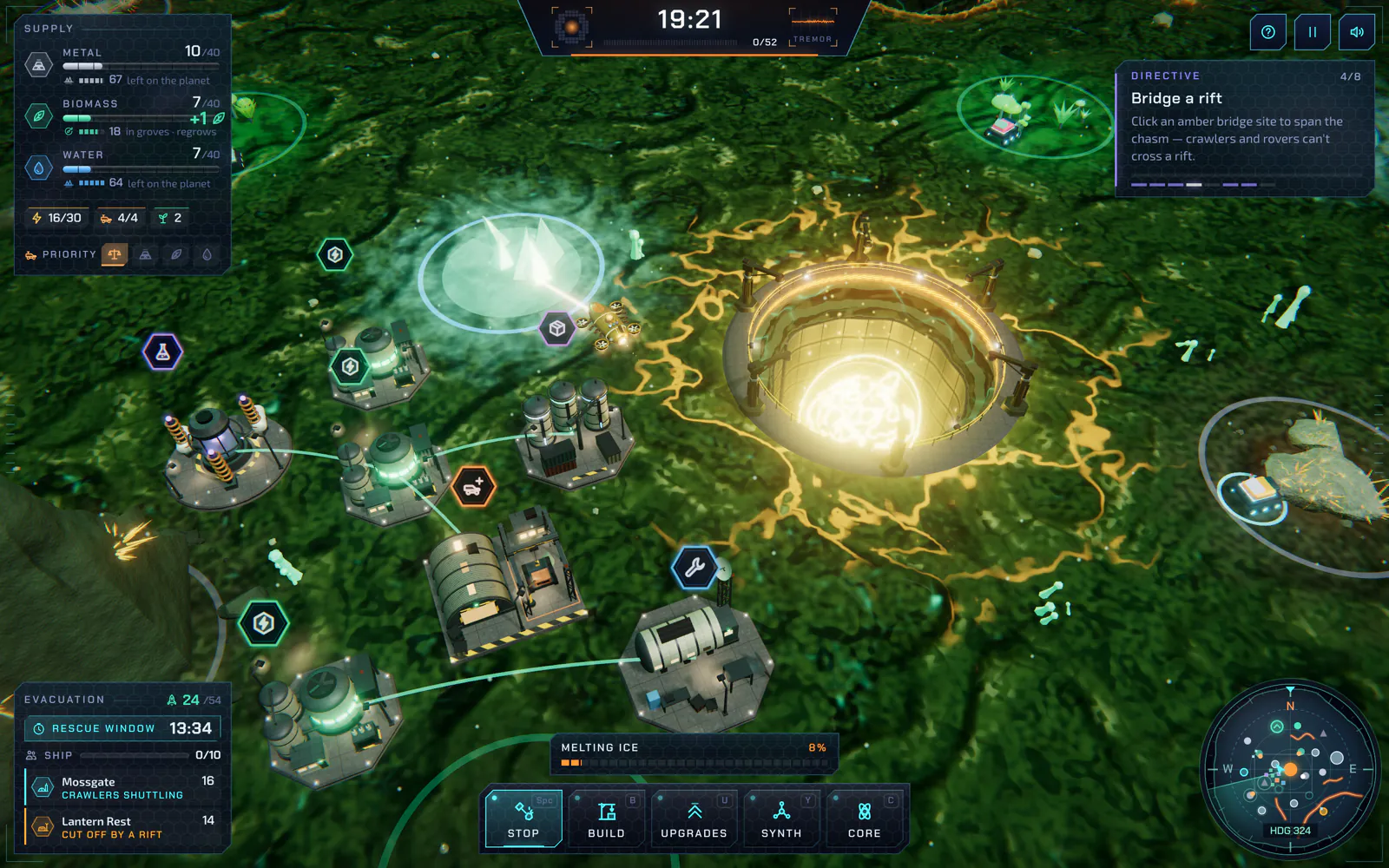
    A base on Nomad Clemens: generators, a Rover Assembly and Storage Depots beside the core's borehole, with the directive to bridge a rift.

    Power Generator

    Power
    Cost
    1 metal 4 water 4 biomass
    Power
    +10
    Up to
    4

    Bio-reactor that produces 10 power for your other buildings.

    Build it first: every other structure needs its power, and you can only place one while there's power to spare.

    Rover Assembly

    Automation
    Cost
    6 metal 2 water
    Power
    −4
    Up to
    2

    Builds mining rovers that gather resources automatically. Supports 4 rovers.

    Worth it when deposits are far apart. Each rover costs just 1 metal, and mines the same finite deposits you do.

    Storage Depot

    Capacity
    Cost
    5 metal 2 biomass
    Power
    −2
    Up to
    3

    Adds +15 storage for every resource type.

    Build one when mining keeps stopping at a full canister: bigger stockpiles mean fewer trips.

    Engineering Bay

    Upgrades
    Cost
    4 metal 4 water 4 biomass
    Power
    −4
    Up to
    1

    Unlocks ship and rover upgrades: engines, laser, drills and cargo pods.

    Upgrades cost metal and water too. On a tight planet, weigh each one against the lattice budget.

    Molecular Synthesizer

    Special pieces
    Cost
    8 metal 8 water 8 biomass
    Power
    −6
    Up to
    1

    Fabricates special lattice pieces (single cells, bars, crosses) for the core.

    Bars and Crosses need far less metal and water per cell than plates and elbows, and a Nano Patch plugs any single gap. It's the way out of a tight budget.

  3. Step 03

    Upgrade

    With a powered Engineering Bay, press U (or tap Upgrades) to refit your ship and rovers. Each upgrade has three levels, paid for from the same supply as the lattice, so weigh each one against the lattice budget.

    UpgradeStandardLevel 1Level 2Level 3
    Ion EnginesShip flies faster.Speed 16Speed 19.53 metal 2 waterSpeed 235 metal 3 waterSpeed 277 metal 4 water 2 biomass
    Mining LaserMine, melt and crack faster — giant deposits most of all.1.25 s per unit0.85 s per unit3 metal 2 biomass0.65 s per unit5 metal 3 biomass0.5 s per unit7 metal 2 water 4 biomass
    Rover DrillsRovers extract resources faster.4.5 s per unit3.6 s per unit4 metal 2 water2.9 s per unit6 metal 3 water2.3 s per unit8 metal 4 water 2 biomass
    Cargo PodsExtra storage for every resource, and 4 more seats for evacuees.No extra storage+6 storage · +4 seats4 metal 2 biomass+12 storage · +8 seats6 metal 3 biomass+18 storage · +12 seats8 metal 2 water 4 biomass

    Engine and laser figures are the Hearthward's. Every ship's upgrades scale from its own speed and laser.

  4. Step 04

    Evacuate

    Every colony has people to get off the planet. Crawlers drive colonists to the ark where a road reaches it. Fly to a colony to board the rest (watch the seat count), then unload them at the ark.

    • Rifts can cut a colony off. Click an amber bridge site to span the chasm for 4 metal and 3 biomass, so crawlers and rovers can get through.
    • Some colonies have no vehicles at all, and some can only be reached by air.
    • Cargo Pods add 4 seats a level, and the Quickhand's Tractor Ramp boards colonists twice as fast.
    • On harder planets, quakes close the rescue window well before the core gives way.
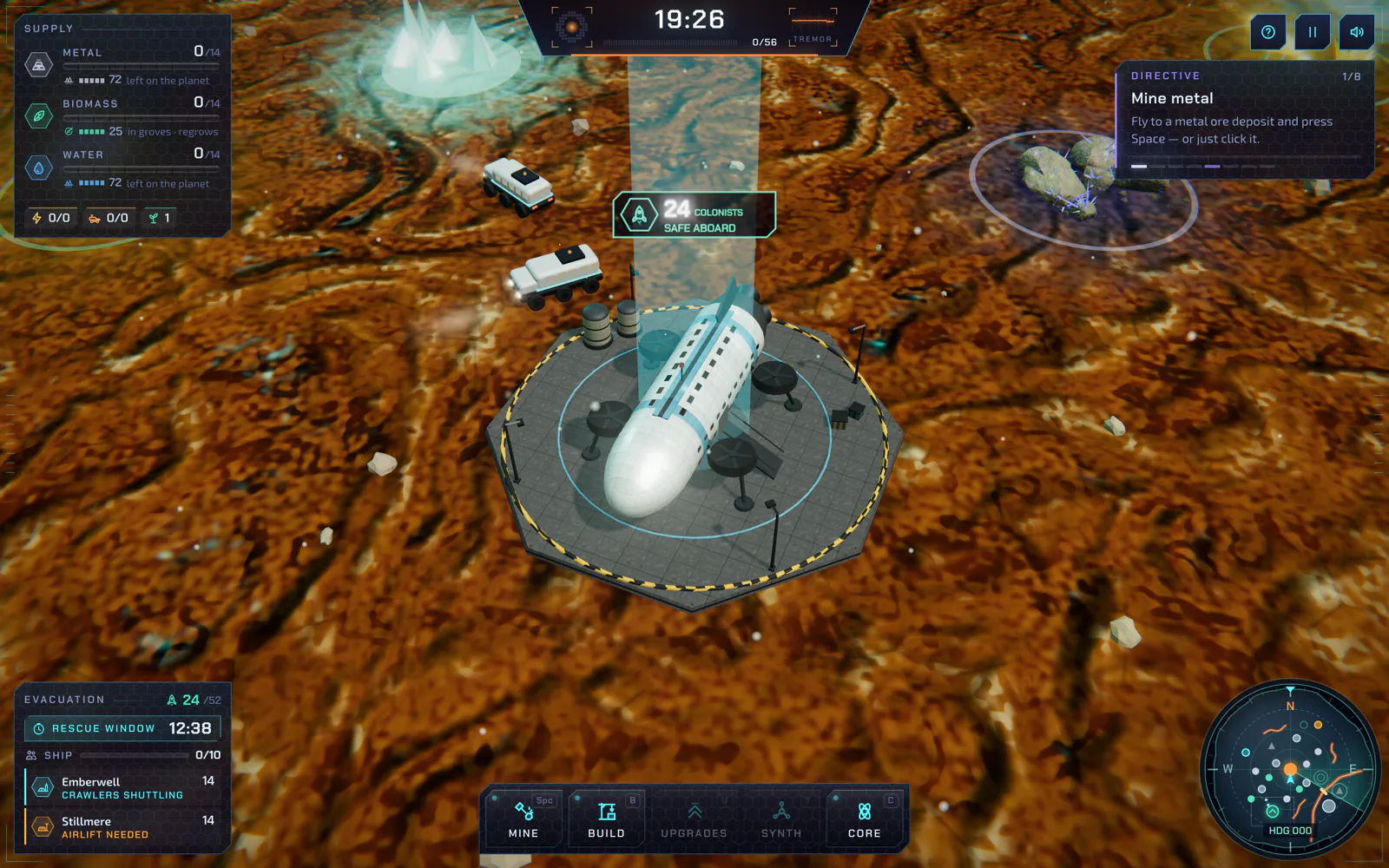
    Crawlers bring colonists to Ark Vesper on the rust and ochre ground of Nomad Calida.
  5. Step 05

    Stabilize

    Press C (or tap the core) to open the stabilizer. The containment lattice is a ring of cells around the core's nucleus, and every cell must be sealed to win. Each piece costs one resource per cell.

    Not every mix of pieces can tile a lattice. The lattice budget lists the mixes that can seal it, and which of them the planet can still pay for. H gives a hint, and clicking a placed piece takes it back out for a full refund.

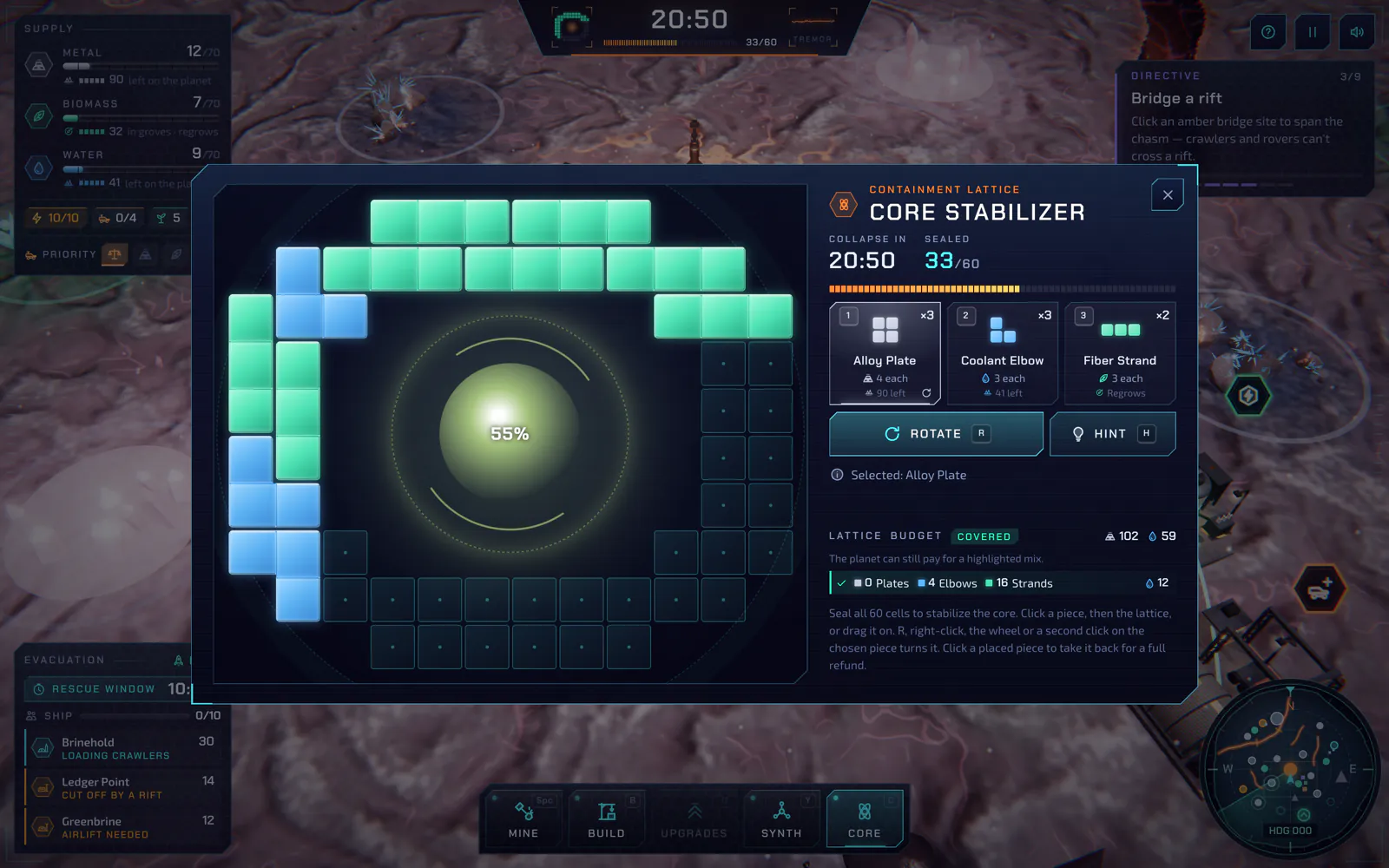
    The core stabilizer on Nomad Salina: Alloy Plates, Coolant Elbows and Fiber Strands fitted around the core, with the lattice budget beside them.

    Base pieces

    Alloy Plate

    A 2×2 square, one metal per cell.

    4 metal

    Coolant Elbow

    A 3-cell L, one water per cell.

    3 water

    Fiber Strand

    A 3-cell line, one biomass per cell.

    3 biomass

    Molecular Synthesizer pieces · Y

    Nano Patch

    A single cell that plugs any gap.

    1 metal 1 water 1 biomass

    Lattice Bar

    A straight 4-cell strut.

    2 metal 2 water

    Stabilizer Cross

    A 5-cell plus that locks gaps together.

    2 metal 2 water 2 biomass

    Synthesized pieces use less metal and water per cell than the base pieces, and a Nano Patch plugs any single gap.

  6. Step 06

    Hold off the pirates

    Pirates raid Nomad Favilla, Nomad Canora and Nomad Gravis. Your ship is unarmed, but the automated defense turrets aren't, and they're wrecked when you arrive.

    • A minute before each raid, the Defense channel warns you which way the pirates are coming from, and a marker leads you to the nearest wrecked turret.
    • Click a turret (or press Space beside it) and your ship welds it back online for 2 metal and 2 biomass. Online turrets shoot raiders down on their own. Raiders shoot back, and patching a damaged turret costs 1 metal.
    • On Favilla the raiders loot a colony, and its people can't leave until the raiders are shot down or gone. On Canora and Gravis they go for the core, tearing pieces out of the lattice and hauling off stored supplies.
    • Shooting a raider down returns everything it carried, and raids never take more than the planet can spare, so the lattice can always still be finished.

Controls on Mac

W A S D or arrowsFly (relative to the camera)
Left clickFly to a point, mine a deposit, repair a turret, select buildings and rovers
SpaceMine, melt, crack or plant at the nearest deposit, or repair a turret beside you
Left drag · right drag or Q E · wheelPan · rotate · zoom the camera
FRe-center the camera on the ship
B U Y CBuild · Upgrades · Synthesizer · Core stabilizer
1–9Pick a building or a lattice piece
R, right click or wheelRotate a building or lattice piece
H · P or Esc · MField manual (a hint in the core panel) · pause · mute

Controls on iPhone and iPad

Tap to fly, mine or repair a turret, drag to pan, pinch to zoom, and twist with two fingers to rotate. The bottom bar holds every action, and building placement shows Place, Rotate and Cancel buttons. In the core panel, tap a piece and then the lattice (or drag it there), and tap a placed piece twice to remove it.

The HUD

  • Containment gauge: the collapse clock, a live miniature of the lattice and a tremor trace that grows violent as collapse nears.
  • Supply: what you hold, what's left on the planet, power, rovers and seeds.
  • Directive uplink: the current objective, with a pip for each step.
  • Comms: messages tagged by channel: Ops, Core, Works, Grove, Survey, Defense, Fleet and more.
  • Gravimetric scanner: a heading-up sweep of the surface. Click it to fly anywhere.

The mission auto-saves, so you can leave mid-mission and pick up where you left off. The pause menu has High, Medium and Low graphics presets, and the game steps down a preset on its own if the frame rate stays low.

Service record

Stars, ranks and achievements

Every planet can earn three stars, every win earns XP toward a service rank, and Game Center keeps the leaderboards and achievements.

  • One star for sealing the core and evacuating every colonist.

  • One star for finishing with a quarter of the core clock to spare.

  • One star for getting everyone aboard with a quarter of the rescue window to spare.

Ranks and XP

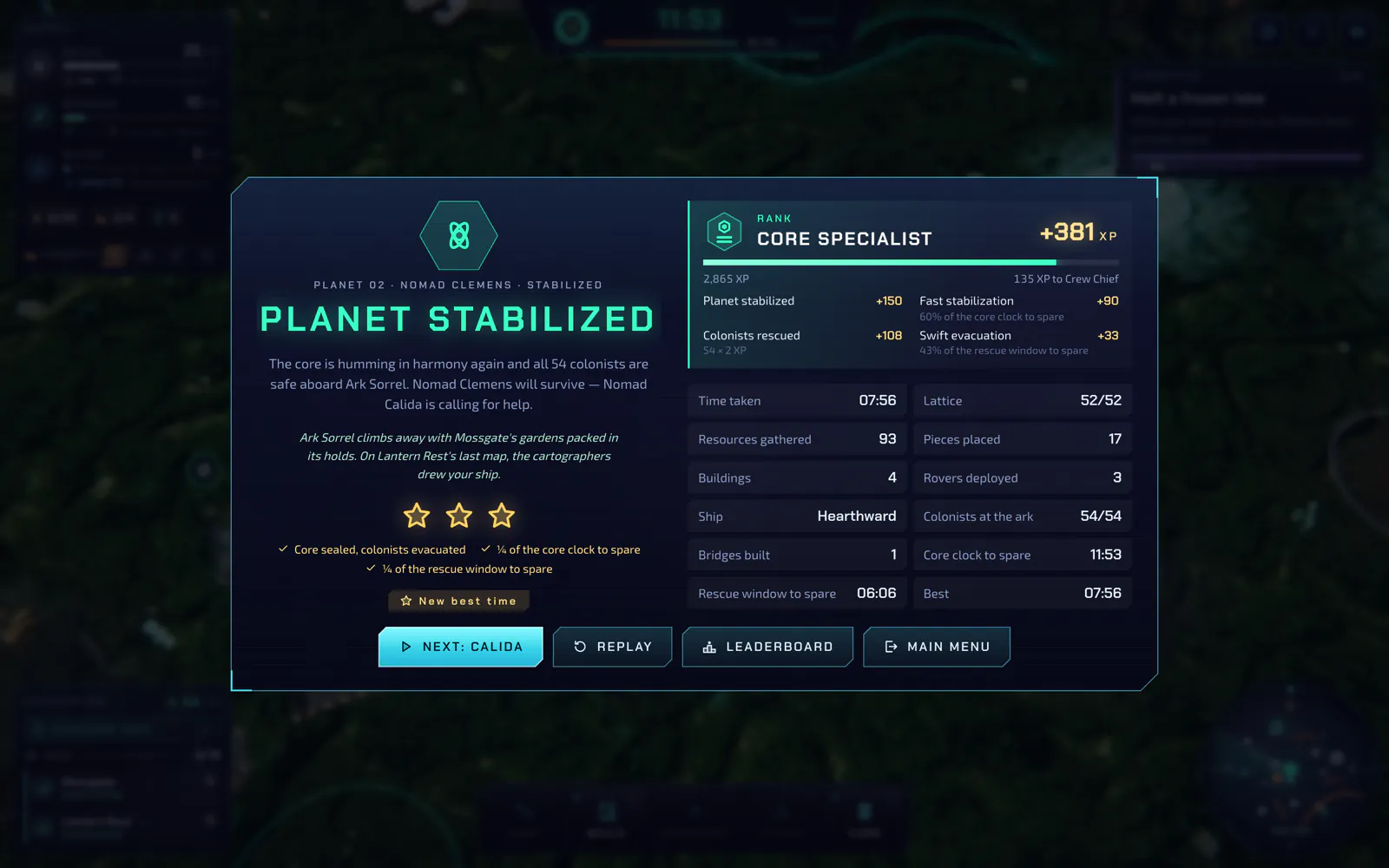
Every win earns XP toward a service rank, from Recruit to Void Marshal at 12,000 XP. The end screen itemizes what you earned:

  • The planet's XP for a win: Training 100, Easy 150, Medium 250, Hard 400, Expert 600.
  • Up to as much again for a fast stabilization, by the share of the core clock still left.
  • 2 XP for each colonist rescued.
  • Up to half the planet's XP for a swift evacuation, by the share of the rescue window left once everyone is aboard.
  • The planet's XP once more the first time you stabilize it.
The end screen after stabilizing Nomad Clemens: three stars, a new best time and the XP earned toward the next rank.
  • Recruit0 XP
  • Cadet250 XP
  • Technician700 XP
  • Lattice Engineer1,300 XP
  • Core Specialist2,100 XP
  • Crew Chief3,000 XP
  • Warden4,200 XP
  • Commander6,000 XP
  • Vanguard8,500 XP
  • Void Marshal12,000 XP

17 Game Center achievements · 840 points

  • Training Complete

    Stabilize Nomad Tiro, the training world.

    10 points
  • Garden Keeper

    Stabilize Nomad Clemens, the garden world.

    20 points
  • Spring Crossing

    Stabilize Nomad Calida and its hot springs.

    30 points
  • Salt Runner

    Stabilize Nomad Salina on its salt flats.

    40 points
  • Cinder Guard

    Stabilize Nomad Favilla under the pirates' noses.

    50 points
  • Storm Breaker

    Stabilize Nomad Canora's 96-cell lattice.

    70 points
  • Heart of Gravis

    Stabilize Nomad Gravis, the heaviest core in the sector.

    100 points
  • Textbook Seal

    Earn all three stars on a planet.

    30 points
  • Perfect Sector

    Earn all three stars on every planet.

    100 points
  • Against the Clock

    Stabilize a planet with half of the core clock to spare.

    40 points
  • Swift Evacuation

    Bring every colonist to the ark with half of the rescue window to spare.

    40 points
  • Ark Keeper

    Bring 250 colonists to the ark.

    30 points
  • Exodus

    Bring 1,000 colonists to the ark.

    60 points
  • Pirate Hunter

    Shoot down 20 pirate raiders.

    40 points
  • Core Specialist

    Reach the rank of Core Specialist.

    30 points
  • Commander

    Reach the rank of Commander.

    50 points
  • Void Marshal

    Reach the highest rank, Void Marshal.

    100 points

Leaderboards

Each planet has a Game Center leaderboard for its best time, and wins on the Hard and Expert planets (Canora and Gravis) also go on a Pro leaderboard that starts over every month.

Best times

Your best time on every planet is saved, so there's always a record to beat, and the star you missed is always waiting on a replay.

iPhone · iPad · Mac

Free to start, one purchase for the rest

The game is free to download, and one in-app purchase opens the rest of the sector for good. There are no subscriptions and no ads.

Free edition Free

  • Nomad Tiro, Nomad Clemens and Nomad Salina
  • The Hearthward, the Taramyn fusion tender
  • Guided training, the Chronicle, ranks, and Game Center leaderboards and achievements

Full version One-time purchase

  • 4 more planets: Nomad Calida, Nomad Favilla, Nomad Canora and Nomad Gravis
  • 4 more ships: the Seedwarden, Stonebreaker, Quickhand and Stillpoint
  • One purchase for every iPhone, iPad and Mac signed in to the same Apple Account, with Restore Purchase in the store panel

Planets open in order in both editions: stabilize each one to reach the next.

Privacy

Private by design

Void Trails for iPhone, iPad and Mac collects no data and no personal information, and no data is ever sold. There are no accounts, no ads and no trackers, and the game plays fully offline. The only analytics are the default App Store analytics Apple provides to every developer. We value your privacy, and we designed the game around it from the start.